Leave Your Message
0%

Choosing the right Mccb Breaker is a practical decision, not a product-size comparison. A Molded Case Circuit Breaker Mccb must match the system’s voltage, current, fault level, and operating environment. A warehouse panel may need different protection than a motor control cabinet or a commercial building.

Tom Short, an electrical protection engineer and Schneider Electric Distinguished Engineer, has emphasized, “Protection is not just about interrupting current; it is about coordinating the system.” This principle guides every reliable selection. The breaker must open quickly during a fault, yet remain stable during normal starting currents. That balance matters.

Start with the load.

Check the continuous current first. Then review the available short-circuit current, poles, trip unit, and installation temperature. A 250-ampere frame does not always provide 250 amperes of usable protection. Ambient heat, enclosure size, and conductor rating can change the result.

Breaking capacity deserves special attention. If the breaker’s interrupting rating is too low, the installation may face severe equipment damage during a fault. Selectivity also matters. A downstream breaker should ideally trip before the upstream device, reducing unnecessary shutdowns.

Manufacturers such as Schneider Electric, Eaton, and ABB publish detailed technical data. Use those documents, not assumptions. Installation conditions can expose weaknesses that catalog figures hide.

A perfect choice on paper may still fail in service. Motor inrush, frequent switching, dust, and poor maintenance can alter performance. Qualified engineers should verify the design against applicable electrical standards and local requirements before installation.

How to Choose the Right MCCB Breaker?

What Is an MCCB and How Does It Work?

An MCCB, or molded case circuit breaker, protects electrical circuits from excessive current. It usually combines thermal and magnetic protection. The thermal element responds to sustained overloads, such as too many machines sharing one circuit. The magnetic element reacts almost instantly to a short circuit. Some MCCBs use electronic trip units for more precise settings. The breaker can also disconnect power manually during maintenance. It is a protective device, not a cure for poor wiring.

In practical inspections, I check the load, cable rating, system voltage, and available fault current before choosing an MCCB. Its interrupting capacity must exceed the possible fault current at the installation point. Pole configuration matters too, especially in three-phase systems. Adjustable trip settings can improve coordination between upstream and downstream protection. However, incorrect settings may delay disconnection. I still recheck them after commissioning because assumptions are easy to miss. No breaker is perfect.

Tips: Choose an MCCB with a suitable continuous current rating, but avoid oversized protection. Confirm the enclosure, ambient temperature, and installation environment. Check terminals for firm connections and signs of heat. Follow IEC 60947-2 or the applicable local standard. Only qualified personnel should install, test, or adjust the device. Keep records of trip settings and inspection results.

How to Choose the Right MCCB Breaker?

An MCCB (Molded Case Circuit Breaker) protects low-voltage circuits from overloads and short circuits. Select an MCCB by comparing the circuit's design current, system voltage, fault level, number of poles, and required trip characteristics. The chart below shows the estimated three-phase load power at 400 V with a power factor of 0.8 for several common current ratings.

Use an MCCB with a continuous current rating above the calculated design current, while ensuring that its interrupting capacity is equal to or greater than the prospective short-circuit current at the installation point. Final selection must also consider cable ampacity, ambient temperature, coordination, and local electrical regulations.

Identify the Electrical System’s Basic Requirements

Choosing the right Moulded Case Circuit Breaker Mccb starts with the electrical system’s basic requirements, not the cabinet size. Record the system voltage, phase arrangement, operating frequency, and continuous load current. A 400 V, three-phase workshop may need a 160 A breaker, but that rating must match the measured demand and cable capacity. Oversizing can delay protection.

Fault current is equally important. The breaker’s interrupting capacity must exceed the prospective short-circuit current at its installation point. IEC 60947-2 provides the technical framework for testing low-voltage circuit breakers. The IEA’s Electricity 2024 report expects global electricity demand to grow by about 4% annually through 2026. More load does not automatically mean a larger breaker. It means better assessment.

Check the trip curve, pole count, insulation voltage, ambient temperature, and coordination with upstream protection. In a dusty plant room, heat and contamination can affect performance. Field inspections often find loose terminals, incorrect cable lengths, or assumptions copied from older drawings. That is risky. For example, a 25 kA breaker may be inadequate where fault calculations reach 35 kA. An electrical engineer should verify short-circuit levels, selectivity, and installation conditions before commissioning. Recheck the design after adding motors, chargers, or solar equipment. The original calculation may no longer be reliable.

Calculate the Required Current and Breaking Capacity

Choosing a Mccb Moulded Case Circuit Breaker starts with the required current, not the enclosure size. For a three-phase load, use I = P ÷ (√3 × V × power factor). A 30 kW motor at 400 V and 0.90 power factor draws about 48 A. That does not automatically justify a 50 A breaker. Cable ampacity, ambient temperature, grouping, motor starting current, and continuous loading can require a 63 A frame with adjusted protection settings. IEC 60364-5-52 emphasizes coordination between conductor capacity and protective devices. A neat calculation can still mislead.

Breaking capacity must match the prospective short-circuit current at the installation point. Under NFPA 70, 2023 edition, the interrupting rating cannot be lower than the available fault current. IEC 60947-2 separates ultimate breaking capacity, Icu, from service breaking capacity, Ics. For example, if a panel has 18 kA available fault current, selecting a breaker rated only 10 kA creates a serious design failure. Obtain the utility fault level, transformer impedance, and cable length from verified project documents. Field conditions are often less tidy than drawings suggest.

Tips: Calculate the load current at the lowest expected voltage. Apply manufacturer-published derating data. Check Icu and Ics, not only the ampere rating. Record the calculation and have a qualified engineer review it. Shortcuts feel efficient, but they often hide the highest risk.

Select the Appropriate Voltage, Poles, and Trip Unit

How to Choose the Right MCCB Breaker?

Voltage selection starts with the system’s nominal voltage and fault conditions. Match the MCCB voltage rating to the circuit, or select a higher approved rating. For a 480 V three-phase panel, a 240 V breaker is unsuitable. The interrupting rating must also exceed the available short-circuit current. This requires a proper fault study, not an estimate.

Pole selection depends on the system arrangement. Three-pole units suit many three-phase circuits. Four-pole units may disconnect the neutral when the design requires it. Do not switch a grounded conductor casually. Local electrical rules and the grounding method matter.

Trip-unit choice controls protection quality. Thermal-magnetic units fit simpler loads and stable operating conditions. Electronic trip units provide adjustable long-time, short-time, instantaneous, and ground-fault functions. Set these values from conductor ampacity, motor starting current, and coordination studies.

The IEA’s Electricity 2024 report estimated data centers used about 460 TWh globally in 2022. It expects demand to exceed 1,000 TWh by 2026.

The IEA’s Renewables 2024 report also forecasts nearly 5,500 GW of new renewable capacity by 2030. Larger and more variable loads make adjustable protection increasingly valuable. Still, more settings do not automatically mean safer protection.

Tips: Verify voltage, pole count, and interrupting capacity on the nameplate. Compare the breaker with the cable size and upstream protection. Test trip settings after installation. A rushed selection can look correct and remain wrong. Review the design with a qualified electrical professional.

Match the MCCB to Cable Size and Installation Conditions

Choosing an MCCB Breaker starts with the cable, not the load nameplate. Confirm conductor material, cross-sectional area, insulation temperature, and allowable ampacity. The breaker’s continuous rating should not exceed the cable’s adjusted ampacity. That adjustment matters. A conductor rated for 100 A in free air may carry less inside hot, crowded trunking. Use local electrical codes and verified trip data.

Installation conditions can change the correct breaker size. Check ambient temperature, cable grouping, enclosure ventilation, installation method, and altitude. For example, six loaded cables bundled together can retain heat and require derating. A dusty outdoor enclosure may also need a different thermal setting or enclosure rating. Do not select only by matching breaker amperes to cable labels. The prospective short-circuit current must remain below the MCCB’s interrupting capacity. Also verify system voltage, pole configuration, neutral protection, and available trip adjustments.

During inspections, I compare the design calculation with the actual cable route. A cable may leave a ventilated tray and pass through insulation or a sealed gland. That short section can govern the protection decision. Small details matter. If the calculation feels rushed, pause and recheck the weakest section. A qualified electrical professional should confirm coordination, selectivity, and testing before energization. Record the final route, derating factors, and trip settings on the inspection sheet.

Check Protection Coordination and Safety Standards

How to Choose the Right MCCB Circuit Breaker?

Protection coordination should guide every MCCB Circuit Breaker selection. The device must isolate faults without shutting down healthy circuits. Check the trip curves for long-time, short-time, instantaneous, and ground-fault protection. Then compare them with downstream breakers and upstream fuses. A practical test involves simulating a short circuit at the farthest load. Only the nearest protective device should trip.

Small details matter.

IEC 60947-2 sets key requirements for low-voltage circuit breakers, including performance and testing. NFPA 70B emphasizes documented electrical maintenance programs for safer equipment operation. NFPA research also reports that electrical distribution and lighting equipment contributes to tens of thousands of U.S. home fires each year. These figures do not directly predict industrial failures, but they show why loose terminals, overloaded conductors, and poor maintenance deserve attention.

Safety checks should include rated voltage, interrupting capacity, enclosure conditions, temperature, and available fault current. An MCCB with insufficient interrupting capacity can fail violently during a fault. Installation teams should verify settings after commissioning, not rely only on factory defaults. Coordination studies can reveal unexpected overlap between trip zones. They can also expose gaps.

Perfect coordination is not always possible. High selectivity may increase fault-clearing time and arc-flash energy. Engineers must balance continuity, equipment damage, and worker exposure. Recheck the design after transformer, cable, or motor changes. A forgotten system modification can make an approved protection study unreliable.

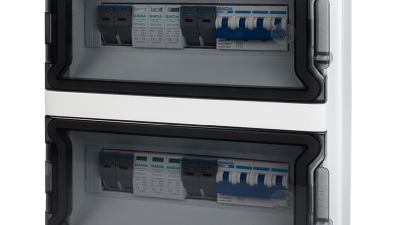
SCBP-4/2 PV Combiner Box: Safe, Reliable 4-Input and 2-Output DC Power Management

The SCBP-4/2 PV Combiner Box is designed for four-string solar photovoltaic systems that require safe, organized DC power management. With four inputs and two outputs, it combines string circuits efficiently while supporting dependable current distribution. Its IP65-rated enclosure helps protect internal components from dust and water, making it suitable for demanding outdoor installations. The box also provides essential surge defense and overload protection on the DC side.

A PB8Z-63 DC circuit breaker offers reliable overload and short-circuit protection while complying with IEC 60947-2 requirements for photovoltaic and DC applications. Its non-polarity design simplifies wiring and helps reduce installation errors. For additional protection against transient voltage, the integrated Type 2 DC surge arrester supports up to 1000V maximum operating voltage and a 40kA discharge capacity, meeting IEC/EN 61643-31 Type 2 standards.

The NRD-30 DC fuse supports 1000V operation and uses a 10×38mm, 16A fuse link for fast fault isolation and convenient replacement. An optional LED indicator provides a clear visual reference for fuse status, helping technicians identify maintenance needs more efficiently. Together, the breaker, surge arrester, and fuse create a practical protection system for stable and reliable PV string operation.

FAQS

What does an MCCB protect against?

An MCCB protects circuits from sustained overloads and sudden short circuits. Thermal protection responds to heat from excessive current. Magnetic protection reacts almost instantly. It is not a cure for poor wiring.

How does thermal protection work?

The thermal element responds when excessive current continues over time. For example, several machines may overload one circuit. The element heats and trips the breaker. The response is slower than magnetic protection.

What happens during a short circuit?

The magnetic element detects a very high current. It can disconnect power almost immediately. This helps limit damage to cables and equipment. No breaker is perfect.

How should I select the correct MCCB voltage?

Match the breaker’s voltage rating with the circuit’s nominal voltage. A higher approved rating may be acceptable. A 240-volt breaker is unsuitable for a 480-volt panel. Check fault conditions too.

How do I choose the correct number of poles?

Pole selection depends on the system arrangement. Three-pole breakers commonly suit three-phase circuits. Four-pole versions may disconnect the neutral when required. Never switch a grounded conductor casually.

What is an interrupting rating?

The interrupting rating shows the fault current the MCCB can safely stop. It must exceed the available short-circuit current. Use a proper fault study, not a rough guess. Estimates can fail badly.

Should I choose an adjustable electronic trip unit?

Adjustable units can set long-time, short-time, instantaneous, and ground-fault protection. They suit systems with changing loads or coordination requirements. More settings do not automatically create safer protection. Incorrect settings may delay tripping.

What details should be checked before installation?

Check load current, cable rating, voltage, poles, and available fault current. Confirm the enclosure and ambient temperature. Inspect terminals for loose connections or heat marks. Small details matter.

Who should install or adjust an MCCB?

Qualified electrical personnel should install, test, and adjust the device. They should compare settings with conductor capacity and motor starting current. Record the final settings and inspection results. I would recheck them after commissioning.

Conclusion

Choosing the right Mccb Breaker begins with understanding how it protects an electrical system from overloads and short circuits by interrupting excessive current. Start by identifying the system’s basic requirements, including the operating voltage, load type, expected demand, and available fault current. Calculate the required continuous current and select a breaker with an appropriate rating and breaking capacity to safely handle potential faults.

Next, confirm the correct voltage class, number of poles, and trip unit characteristics for the application. The Mccb Breaker should also match the cable size, installation method, ambient temperature, and enclosure conditions so that the entire circuit remains properly protected. Finally, review coordination with upstream and downstream protective devices to reduce unnecessary outages and ensure selective operation where possible. Always verify that the chosen device and installation comply with applicable electrical safety standards, manufacturer instructions, and local regulations.

Sophia

Sophia

Sophia is a seasoned marketing professional with 23 years of experience within the circuit breaker industry. Since joining GACIA in its pivotal years, she has played a crucial role in establishing the company as a leader in low-voltage circuit breaker manufacturing and exports. Her deep......
Previous Why Choose a Molded Case Circuit Breaker for Global Projects?