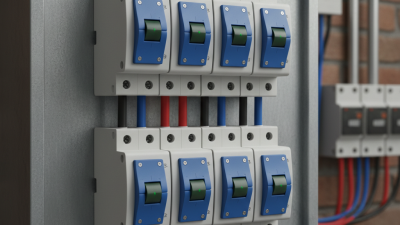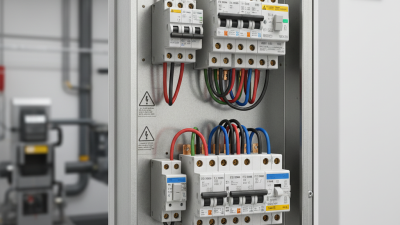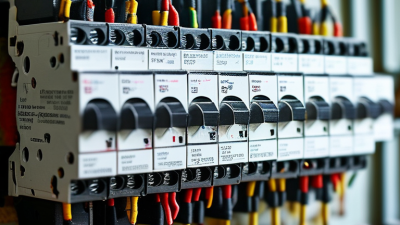
Picking the right RCD manufacturer isn’t just about brand names—it can really impact electrical safety, how much you spend on maintenance, and whether your project runs smoothly. When folks look at options, they often compare brands like Schneider Electric, ABB, Siemens, Eaton, Legrand, Hager, Mitsubishi Electric, Chint, LS Electric, and Gewiss. But here’s the thing: their product specs can vary quite a bit—rated current, number of poles, trip sensitivity, enclosure compatibility, and regional availability. Little details like these can actually make a big difference.
Electrical safety expert Jim Dollard always reminds us that protection only works if installation, testing, and ongoing maintenance are all in sync. That’s a good rule of thumb to keep in mind when choosing an RCD. A reliable device should respond consistently during faults, stay stable during normal leakage currents, and give a clear indication of its status. When inspecting, buyers should pay attention to the quality of test buttons, the strength of terminal connections, datasheet accuracy, and how easy it is to replace parts. For example, a 30mA RCD might be perfect for protecting personnel in many cases, but ultimately, the right choice depends on your specific circuit design and the equipment you’re using.
Performance isn’t the only thing that matters, though. Things like how reliable the power supply is, the quality of tech support, warranty service, certification proof, and how well the distributor covers your area can heavily influence your project long after you’ve installed everything. That’s why this guide looks at ten different manufacturers based on practical factors—not just brand fame. We consider various applications—residential panels, commercial distribution boards, industrial control cabinets, even export projects. There’s no one-size-fits-all ranking because every site has its unique needs.
Keep in mind, a smaller device might save space inside your panel but could offer fewer adjustment options. On the other hand, a high-end RCD might come with more documentation but also cost more to buy. It's a good idea to question those flashy claims, compare test results carefully, and double-check compatibility before placing your order. Sure, mistakes happen, even with careful planning. But making a smart choice from the start can help minimize the headaches if things go wrong.
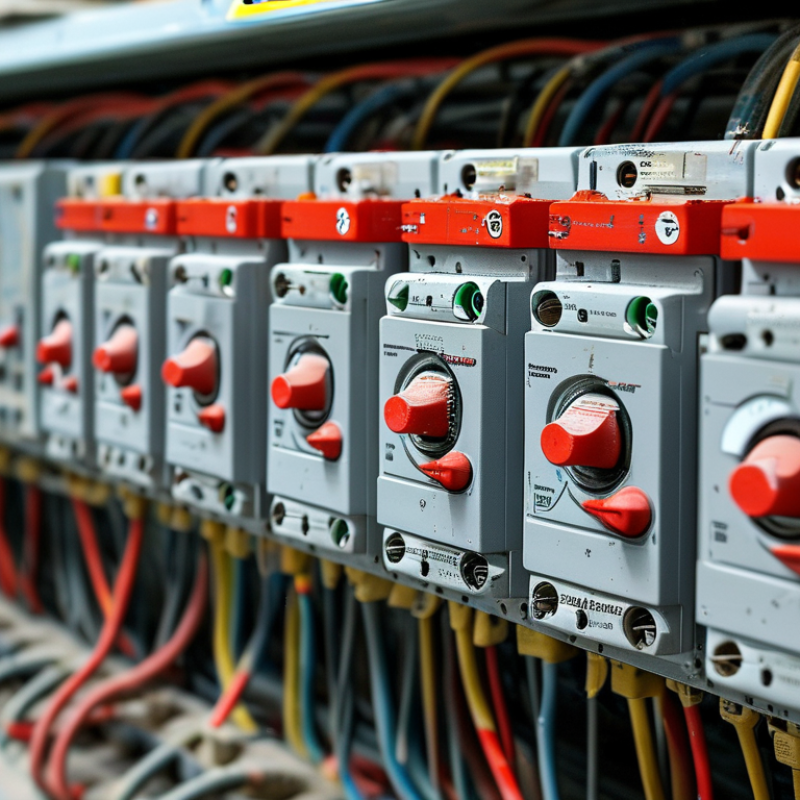
What RCDs Are and Why Global Buyers Need Them
A residual current device, or RCD, monitors electrical current flowing through live and neutral conductors. When it detects an imbalance, it disconnects the circuit within a short time. This response can reduce the risk of electric shock and electrical fires caused by leakage current.
RCDs are not universal safety solutions. They do not replace circuit breakers, grounding systems, or proper insulation. Buyers must match the device with the application, rated current, sensitivity, pole configuration, and local voltage. Type selection also matters. Some equipment produces electronic leakage that basic RCDs may not detect reliably. A qualified engineer should review these conditions before purchase.
Global buyers need more than a low unit price. They need traceable test reports, clear technical drawings, stable production control, and documentation in usable languages. Housing protection is important in dusty workshops or damp utility rooms. Temperature, installation space, and maintenance access also affect performance.
Small details matter. A missing terminal label can delay installation. An unsuitable trip rating can cause nuisance shutdowns. That creates frustration and may hide a deeper design problem. I would never approve a shipment from appearance alone. Sample testing, batch inspection, and independent verification provide stronger evidence. Requirements differ between markets, so local electrical rules must guide the final selection. RCDs protect people only when correctly chosen, installed, and tested.
Residual Current Devices (RCDs) disconnect an electrical circuit when they detect an imbalance between current flowing through live and neutral conductors. The chart shows commonly specified residual operating current ratings (IΔn) used in low-voltage protection systems.
Lower sensitivity ratings, such as 10 mA and 30 mA, are generally selected where enhanced protection against electric shock is required. Higher ratings, including 100 mA, 300 mA, and 500 mA, are commonly considered for equipment, fire-risk, or upstream protection applications. Final selection depends on local electrical codes, system design, earthing arrangements, and the equipment manufacturer’s specifications.
Evaluating RCD manufacturers requires more than comparing catalogue prices. Check rated current, residual operating current, pole configuration, and trip time. A suitable device must match the intended circuit and local installation conditions. Ask for current test reports, calibration records, and conformity documents. These records reveal more than polished sales language.
Request samples from different production batches. Test their test buttons, terminal strength, trip consistency, and temperature performance. An experienced supplier should explain differences between Type AC, Type A, and other suitable categories. Ask how production defects are isolated and traced. Factory audits can confirm testing equipment, worker training, incoming inspection, and final packing procedures. Small details matter.
International purchasing also depends on communication and after-sales control. Review warranty terms, replacement procedures, packaging design, and export experience. Confirm whether product labels, manuals, and certificates match the shipped model. A reliable manufacturer should provide clear answers without avoiding technical questions. Be careful with unusually low quotations. They may reflect reduced testing, weaker materials, or incomplete documentation. That is not always true, but it deserves investigation. I have seen buyers focus heavily on unit cost and overlook delayed samples or inconsistent batches. A written quality agreement can prevent painful misunderstandings. Still, no document replaces independent verification before a large order. 云鼎
Manufacturer 1 focuses on compact RCDs for crowded consumer units. Manufacturer 2 is known for stable Rcd 30ma devices used in homes, offices, and small workshops. Manufacturer 3 develops high-current models for commercial distribution boards. Its terminals remain firm after repeated cable changes. Manufacturer 4 emphasizes surge resistance for regions with unstable electrical networks.
Manufacturer 5 produces selective RCDs that coordinate better with upstream protection. Manufacturer 6 specializes in Type A devices for modern equipment with electronic power supplies. Manufacturer 7 offers sensitive portable units for construction and maintenance work. Manufacturer 8 supports harsh environments with sealed housings and improved corrosion resistance. Manufacturer 9 combines RCD protection with circuit breakers, saving panel space. Manufacturer 10 concentrates on testing equipment, calibration support, and clear installation documentation.
Product strength alone does not prove reliability. A buyer should inspect trip-time reports, temperature-rise data, and factory quality records. Field experience also matters. A device may pass laboratory tests yet confuse installers with poor terminal markings. That detail is easy to overlook. I would compare warranty terms, local technical support, and replacement availability before placing a large order. Some manufacturers publish impressive specifications, but their real-world documentation can feel incomplete. Independent verification is still necessary.
For Rcd 30ma selection, confirm the rated current, trip curve, pole arrangement, and compatibility with the site’s earthing system. Viewing these details together gives procurement teams a more practical basis for comparison.
When comparing the top ten RCD manufacturers, global buyers should examine certification before price. IEC 61008 covers RCCBs, while IEC 61009 covers RCBOs with overcurrent protection. These devices must match local wiring rules and declared test conditions. Type AC detects sinusoidal alternating leakage. Type A also detects pulsating direct current, common in appliances with electronic power supplies. Type F supports mixed-frequency leakage from variable-speed equipment. Type B detects smooth DC leakage from inverters, electric vehicle chargers, and renewable-energy systems.
Selection becomes more technical with a 3phase Rcd. Check rated voltage, current, pole configuration, short-circuit capacity, and residual operating current. Typical sensitivity choices include 30 mA for additional personal protection and 100 or 300 mA for equipment or fire-risk applications. Type B costs more, but a cheaper Type A may fail in unsuitable DC environments. The IEA Global EV Outlook 2024 reported more than four million public charging points worldwide in 2023. That growth increases the need for correct DC-leakage protection. I have seen installations fail because designers checked current rating but ignored waveform behavior.
Tips: Ask for IEC test certificates, tripping-time curves, and temperature derating data. Confirm whether the device is suitable for 50 Hz, 60 Hz, or both. Test buttons are useful, but they do not replace calibrated verification. One overlooked detail matters: neutral switching and phase labeling must follow the installation standard. Manufacturers sometimes present incomplete data. Recheck it.
| No. | RCD Configuration | RCD Type | Typical Application | Detected Residual Current Waveform | Common Product Standard | Typical Pole Arrangement | Typical Rated Current (In) | Typical Residual Operating Current (IΔn) | Typical Non-Tripping Time | Typical Frequency | Key Technical Consideration |
|---|---|---|---|---|---|---|---|---|---|---|---|
| 1 | General-purpose RCCB | Type AC | Resistive loads, lighting circuits, and basic single-phase installations | Sinusoidal AC residual currents | IEC 61008-1 / IEC 61009-1; corresponding national adoptions may apply | 2P or 4P | 25–100 A | 30, 100, or 300 mA | At least 0.3 s at 50% of IΔn | 50/60 Hz | Not intended for smooth DC residual currents or complex electronic loads |
| 2 | Electronic-load RCCB | Type A | Household appliances, switch-mode power supplies, LED drivers, and IT equipment | AC and pulsating DC residual currents | IEC 61008-1 / IEC 61009-1 | 2P or 4P | 25–100 A | 30, 100, or 300 mA | At least 0.3 s at 50% of IΔn | 50/60 Hz | Usually preferred over Type AC where rectifiers or electronic power supplies are present |
| 3 | Single-phase RCBO | Type A RCBO | Final circuits requiring both residual-current and overcurrent protection | AC and pulsating DC residual currents | IEC 61009-1 | 1P+N or 2P | 6–40 A | 10, 30, or 100 mA | Instantaneous or time-delayed according to the product design | 50/60 Hz | Combines RCD protection with a miniature circuit-breaker function in one device |
| 4 | High-immunity RCCB | Type F | Single-phase variable-speed drives, inverter air conditioners, and modern appliances | Type A waveforms plus mixed-frequency residual currents generated by single-phase inverters | IEC 62423, together with the applicable IEC 61008-1 or IEC 61009-1 requirements | 2P | 25–63 A | 30 or 100 mA | According to the applicable product standard and manufacturer design | 50/60 Hz plus specified higher-frequency components | Offers improved suitability for inverter-driven loads compared with Type A |
| 5 | Three-phase inverter RCCB | Type B | Three-phase drives, photovoltaic inverters, UPS systems, and industrial power converters | AC, pulsating DC, and smooth DC residual currents; specified frequency ranges depend on the product | IEC 62423, with the applicable IEC 61008-1 or IEC 61009-1 requirements | 4P | 40–125 A | 30, 100, 300, or 500 mA | According to the applicable product standard and product design | 50/60 Hz plus specified higher-frequency components | Confirm the manufacturer’s declared operating frequency range and smooth-DC detection capability |
| 6 | Selective distribution RCCB | Type A, selective | Upstream protection in coordinated residential, commercial, and industrial distribution systems | AC and pulsating DC residual currents | IEC 61008-1 / IEC 61009-1, including applicable time-delay requirements | 2P or 4P | 40–125 A | 100, 300, or 500 mA | Intentional time delay; exact limits depend on the selected class and standard | 50/60 Hz | Must be coordinated with downstream instantaneous RCDs for discrimination |
| 7 | Fire-protection RCCB | Type AC or Type A | Protection against insulation-fault currents in main distribution or feeder circuits | Depends on the selected RCD type | IEC 61008-1 or IEC 61009-1 | 2P or 4P | 40–125 A | 100 or 300 mA | Instantaneous or selective, depending on system coordination | 50/60 Hz | Not a substitute for overcurrent protection, arc-fault protection, or fire-risk assessment |
| 8 | Personnel-protection RCCB | Type A, high sensitivity | Socket outlets, bathrooms, outdoor circuits, and other circuits requiring additional protection | AC and pulsating DC residual currents | IEC 61008-1 / IEC 61009-1; installation rules vary by jurisdiction | 2P or 4P | 16–63 A | 30 mA | Fast operation within the applicable standard limits | 50/60 Hz | 30 mA protection is an additional protective measure and does not replace basic insulation or earthing |
| 9 | DC-sensitive industrial RCCB | Type B, selective | Industrial converters, charging infrastructure, large UPS systems, and complex power-electronic installations | AC, pulsating DC, smooth DC, and specified composite residual currents | IEC 62423 with the applicable IEC 61008-1 or IEC 61009-1 requirements | 4P | 63–250 A | 100, 300, or 500 mA | Intentional time delay according to the declared selective characteristic | 50/60 Hz plus specified higher-frequency components | System design must address DC leakage, touch voltage, discrimination, and prospective fault current |
| 10 | Compact appliance RCBO | Type A RCBO | Residential branch circuits, small commercial equipment, and space-limited distribution boards | AC and pulsating DC residual currents | IEC 61009-1 | 1P+N | 6–32 A | 10 or 30 mA | Instantaneous thermal-magnetic overcurrent operation plus RCD tripping according to the device rating | 50/60 Hz | Check terminal capacity, neutral switching arrangement, breaking capacity, and compatibility with the distribution board |
Assessing an RCD manufacturer requires more than comparing prices or catalogue photos. Buyers should examine factory controls, test records, and compliance evidence. A dependable producer can explain how each unit is tested before shipment. Important checks include insulation resistance, trip time, leakage sensitivity, and mechanical endurance. For a Type A Rcd, testing should also consider pulsating direct residual currents from modern electronic loads.
Quality becomes visible in small details. Enclosures should feel solid, with clean moulding and secure terminals. Contact movement must remain consistent after repeated switching cycles. Serious manufacturers usually maintain calibrated test equipment, traceable materials, and documented corrective actions. Ask for production samples, not only polished certificates. A certificate alone is not proof.
Global compliance needs careful verification. Relevant standards may include IEC requirements, while destination markets can demand additional approvals, markings, or national testing. Confirm that the certificate matches the exact model, rating, pole configuration, and production site. Check manufacturing dates and surveillance status too. Documentation can be incomplete. That is a real sourcing risk. Independent laboratory reports and factory audits add useful confidence, especially when buying large volumes. Still, audits capture one moment. Regular performance reviews remain necessary.
Choosing an RCD supplier requires more than comparing prices. The correct Rcd Switch must match your voltage, frequency, pole configuration, and installation environment. A residential panel may need 30 mA protection, while industrial equipment can require a different trip setting. Confirm the required RCD type, such as AC, A, or B, with a qualified electrical professional.
Ask suppliers for current test reports, certification records, and batch traceability. Reliable documentation should identify test standards, rated breaking capacity, temperature limits, and enclosure protection. Request samples before placing a large order. Check terminal strength, label clarity, test-button operation, and trip response using calibrated equipment.
Supply consistency also matters. Review production capacity, inspection procedures, packaging quality, and replacement support. A supplier with local technical assistance can reduce delays when installations fail inspection. Delivery promises should include realistic production and shipping times. Cheap products may create expensive rework.
No checklist is perfect. Field conditions often reveal details missed during purchasing, such as heat inside a crowded cabinet or nuisance trips from variable-speed drives. Discuss these risks openly with the supplier. A dependable partner should explain limitations, not merely claim universal compatibility. Keep written records of approvals, samples, corrective actions, and agreed specifications for every market.
An RCD monitors current in live and neutral conductors. It disconnects the circuit when it detects an imbalance. This can reduce electric shock and leakage-related fire risks.
No. An RCD does not replace circuit breakers, grounding, or proper insulation. Each device performs a different safety function. Using only an RCD leaves gaps.
Match the rated current, sensitivity, pole configuration, and local voltage. The application also matters. A qualified engineer should review the selection before purchase.
Some electronic equipment creates pulsating direct residual currents. A basic RCD may not detect them reliably. The selected type must suit the connected equipment.
Request test reports, technical drawings, and production-control records. Check insulation resistance, trip time, leakage sensitivity, and mechanical endurance. A low price may hide incomplete evidence.
Inspect enclosure moulding, terminal security, and contact movement. Repeated switching should not cause inconsistent operation. Ask for production samples, not polished certificates alone.
No. Confirm the certificate matches the exact model, rating, poles, and production site. Check manufacturing dates and surveillance status. A certificate alone is not proof.
Dust, moisture, temperature, and limited installation space can affect performance. Missing terminal labels may delay installation. An unsuitable trip rating can cause nuisance shutdowns.
Audits provide useful evidence, but they capture only one moment. Independent laboratory reports and batch inspections add confidence. Regular performance reviews remain necessary. I would not approve shipments from appearance alone.
This guide introduces Rcd technology, explaining how residual current devices help protect people, equipment, and electrical systems by detecting leakage currents and disconnecting power when necessary. It outlines why global buyers should consider Rcd products for residential, commercial, industrial, and infrastructure applications, while emphasizing the importance of choosing devices that match local voltage, frequency, installation conditions, and safety requirements.
The article also presents a practical framework for evaluating international manufacturers, including product range, technical performance, manufacturing consistency, certifications, testing procedures, supply capacity, and after-sales support. It compares major Rcd types, sensitivity ratings, pole configurations, tripping characteristics, and applicable international standards. Finally, it explains how buyers can select a suitable supplier by balancing safety, reliability, compliance, customization, delivery capability, and total purchasing cost for their specific market and application.