Leave Your Message
A circuit breaker might be small, but it’s got a pretty demanding job—whenever a circuit gets overloaded or short-circuits, it has to step in and cut the current. For the usual stuff, people tend to go with a Standard Circuit Breaker, and honestly, that makes sense: its ratings, operation, and panel compatibility are all clearly documented. Get the right one, and it can go a long way in protecting your wiring and connected gear from excessive current. Let's be real—breakers aren't some magic fix. They can't catch every electrical fault, and if you get the rating wrong, that circuit might not be as protected as you think.
Picking the right one isn’t just about looking at the amperage printed on the side. You’ve also got to think about voltage, number of poles, interrupting capacity, trip characteristics, and whether it’s even compatible with your panel. So yeah, compare the datasheet with what your circuit actually needs—and don’t skip the manufacturer’s installation and inspection instructions. If you’re replacing an old device or dealing with a panel you’re not familiar with, having a qualified electrician double-check everything is a smart move. Little details can make a big difference.
Look, we all want to save a few bucks and grab something that looks right. But picking a breaker just by price or looks? That's a shortcut worth thinking twice about. A cheaper breaker might seem like a deal, but if its specs don't match what you're actually working with, it's not a good choice. And just because it has the same shape as the old one doesn't mean it'll work the same. In this guide, I'll walk you through when a standard design is actually a smart option, what specifics you need to check, and where it just won't cut it. Sometimes you really do need something different—and that's okay to admit. Honestly, the right pick comes down to your circuit, the gear you're using, and solid technical data — not just whatever the label says.
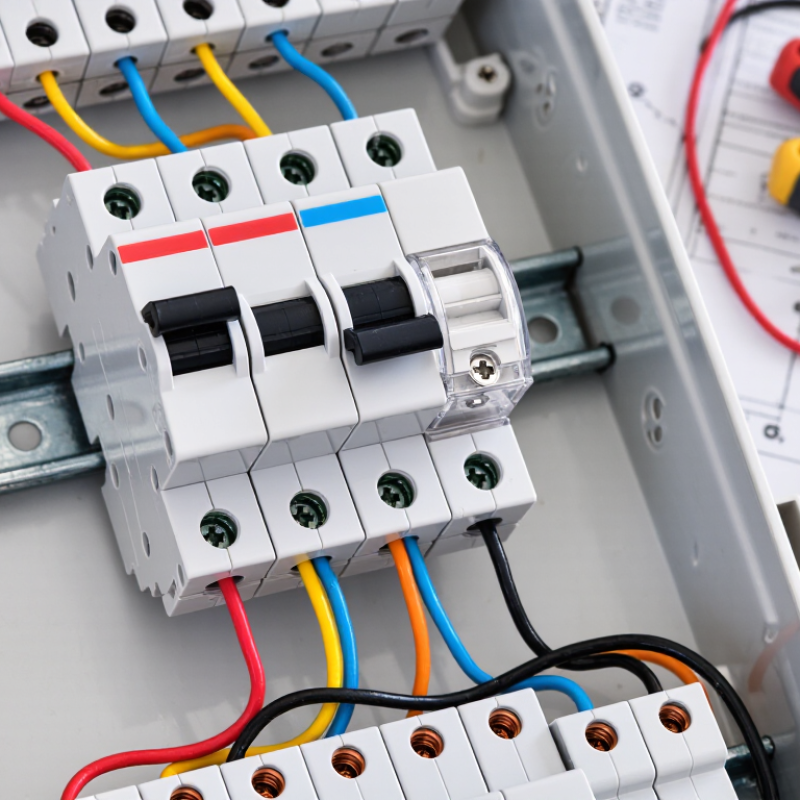
A standard circuit breaker is a resettable protective device that interrupts current when a circuit experiences an overload or short circuit. Its defining details are measurable: rated voltage, rated current, trip characteristics, and short-circuit breaking capacity. IEC 60898-1 covers household and similar AC circuit breakers rated up to 440 volts, 125 amperes, and 25,000 amperes of short-circuit capacity. These limits describe the standard’s scope, not a recommendation for every installation. The correct device depends on the circuit, wiring, and expected fault current.
In practice, an electrician checks the breaker rating against the cable and load, then confirms the panel accepts that device type. A breaker rated too high may fail to protect the wiring properly. Too low, and ordinary equipment startup may cause repeated trips. Small details matter. A standard circuit breaker mainly protects against overcurrent; it does not necessarily detect current leaking to ground. An Rccb Standard device addresses residual-current protection, but typically needs separate overcurrent protection unless the unit combines both functions. The terminology can be confusing, and product labels alone are not enough. Installation conditions and the applicable electrical standard should guide selection.
| Dimension | What Defines a Standard Circuit Breaker | Why It Matters |
|---|---|---|
| Primary purpose | Automatically opens a circuit when current exceeds specified conditions, helping protect wiring and equipment from overcurrent. | Provides a defined protective function rather than serving only as a manual switch. |
| Overload and short-circuit response | Many common low-voltage breakers provide both overload and short-circuit protection. The exact trip characteristics depend on the breaker type and applicable standard. | Helps address both sustained excessive current and high fault current; selection must match the circuit and installation. |
| Trip mechanism | Common miniature circuit breakers use thermal-magnetic operation: a thermal element responds to overloads, while a magnetic element responds to high short-circuit currents. Other breaker designs are also used. | The mechanism influences response behavior and suitability for the protected load. |
| Applicable standards | Requirements depend on location and application. Examples include IEC 60898-1 for certain household and similar installations, and UL 489 for molded-case circuit breakers in North America. | A breaker must be approved or certified for the intended market and installed in accordance with local electrical rules. |
| Rated current | The rated current is marked on the device and indicates its specified current rating under defined conditions. Available ratings vary by product family and jurisdiction. | It must be coordinated with conductor ampacity, load requirements, and applicable code—not selected from load current alone. |
| Voltage and frequency | The breaker is rated for specified AC or DC voltage conditions and, where relevant, system frequency. Ratings are stated on its marking or technical documentation. | Using a breaker outside its voltage or current type rating can prevent safe interruption of a fault. |
| Interrupting capacity | The marked short-circuit or interrupting rating states the maximum fault current the breaker is designed and tested to interrupt under specified conditions. | The rating must be adequate for the prospective fault current at the installation point. |
| Poles and circuit arrangement | Standard breakers are available in different pole configurations for different supply systems. The correct configuration depends on the circuit and local requirements. | Correct pole selection supports appropriate isolation and protection of the intended conductors. |
| Reset and reuse | After a trip, a breaker can generally be reset once the cause has been identified and addressed, provided the device is undamaged and operating correctly. | Unlike a one-time fuse, a breaker is reusable, but repeated tripping should be investigated rather than routinely reset. |
| Interchangeability | A breaker is not universally interchangeable with another breaker that merely has similar current and voltage markings. Panel compatibility, approvals, terminal requirements, and electrical ratings must all be checked. | Using an incompatible breaker can compromise the protection and safe operation of the electrical assembly. |
Note: Ratings and requirements vary by breaker type, installation, and jurisdiction. Confirm device markings, manufacturer documentation, and local electrical regulations before selection or installation.
Automatic welding assembly lines improve miniature circuit breaker manufacturing by combining precise joining operations with continuous material handling. In the welding section, dedicated feeders supply enameled wires, bimetal strips, flexible connectors, and other conductors. A rotary multi-station fixture then coordinates fixed-contact feeding, terminal installation, flux application, and coil placement before welding the coil, terminal, and fixed contact. This repeatable sequence helps maintain consistent weld quality while reducing reliance on manual handling.
After welding, conveyors transfer assemblies directly to the next production stage. Vibratory feeders present components, and a six-axis robot opens the housing and installs internal parts with precision. CCD vision systems monitor critical processes, assess product quality, and sort non-conforming units automatically. Integrated MES/ERP tools support recipe-based parameter control, energy analysis, and remote operation and maintenance, while enabling production data to connect with broader platforms. The modular line can also link to downstream automated testing, creating a coordinated manufacturing flow from component feeding through assembly and inspection.
It interrupts current when a circuit has an overload or short circuit. It can then be reset. Small, but important.
Check rated voltage, rated current, trip characteristics, and short-circuit breaking capacity. The right rating depends on the circuit and wiring.
Not necessarily. It mainly protects against excessive current. Separate residual-current protection may be needed.
Match it to the conductor size, installation conditions, connected loads, and panel compatibility. The appliance label alone is not enough.
No. An oversized breaker may let undersized wiring overheat before it trips. Do not guess.
Note which devices were running and when the trip occurred. Have a qualified electrician investigate. Patterns can help, but they are not a diagnosis.
No. It does not replace arc-fault or ground-fault protection, and it cannot guarantee protection from electric shock.
It deserves attention, not guesswork. A qualified electrician can inspect for loose connections, damage, or wear. I would not dismiss warmth as normal.
A Standard Circuit Breaker is a resettable protective device that helps control the flow of electricity through a circuit. When it detects an overload or short circuit, an internal mechanism interrupts the current to reduce the risk of overheated wiring and equipment damage. Unlike a fuse, it can usually be reset after the cause of the interruption has been identified and corrected. Its straightforward operation and clear trip response make it a practical part of many everyday electrical systems.
Choosing the right breaker means matching its rating to the circuit’s wiring, expected load, and system requirements; a rating that is too high may not provide appropriate protection. Standard breakers are commonly used where basic overcurrent protection is suitable and compatible with the existing electrical setup. By understanding how they detect faults, what safety benefits they provide, and how to select a suitable rating, users can make a more informed choice for routine circuit protection.