




MCCB Uses and Functions in Modern Electrical Systems
Molded Case Circuit Breakers (MCCBs) are widely used in modern low-voltage distribution systems, which must account for higher current levels and fault-breaking requirements. They are able to protect circuits as well as electrical equipment against overloading and short circuits, in addition to providing switching and isolation functions for power distribution systems.
MCCBs are generally preferred for distribution boards, commercial establishments, factories, and similar settings where superior current capacity and a more versatile safety mechanism are needed compared to smaller protection devices used in final circuits.
MCCB Meaning Electrical: What Does MCCB Stand For?
When users look for the MCCB meaning electrical, MCCB is described as the term Molded Case Circuit Breaker. The device is contained in an insulated shell that automatically disconnects the circuit when there are abnormal conditions of overcurrent.
Generally, based on the trip unit and the model, the MCCB is capable of offering short-circuit and overload protection, but other forms of protection and control can still be involved in some designs. This means that the MCCB is a critical component in distributing low-voltage electric power.
MCCB Function in Power Distribution
The primary function of the MCCB is to interrupt any hazardous current before it causes damage to cables, appliances, and subsequent electrical devices.
In the case of an overload, the circuit breaker will activate only if the current stays above the nominal value for a prolonged period of time. In the case of a short circuit, circuit breakers must react instantaneously to stop the short-circuit current.
Miniature Circuit Breakers (MCBs) may not work as regular switches but can be utilized for one-time operation. Some of the available accessories with MCBs vary by design to provide improved control and monitoring functionality.
MCCB Uses in Modern Electrical Systems
In commercial buildings, industrial plants, and other electrical systems with heavy loads, the principal and secondary use of MCCBs is to protect main and sub-distribution.
They can be used to guard against distribution feeders, equipment, electrical machinery, and so on where the expected current or prospective current short-circuit exceeds the limit accepted for smaller breakers suitable for protection.
The appropriate use is determined by things like rated current, system voltage, breaking capacity, pole arrangement, and the nature of the trip mechanism.
MCCB in Electrical Distribution Systems
MCCBs are positioned within the electrical distribution system in that they serve the gap between the smaller devices meant for protecting the final circuits and larger switching devices made for main distribution.
For example, an MCCB may be installed in a main or sub-distribution board to protect downstream circuits while allowing the affected section to be disconnected if an overload or short circuit occurs.
The importance of MCCBs in commercial and industrial installations is the result of the protection capability and coordination in a system.
GACIA MCCB Solutions
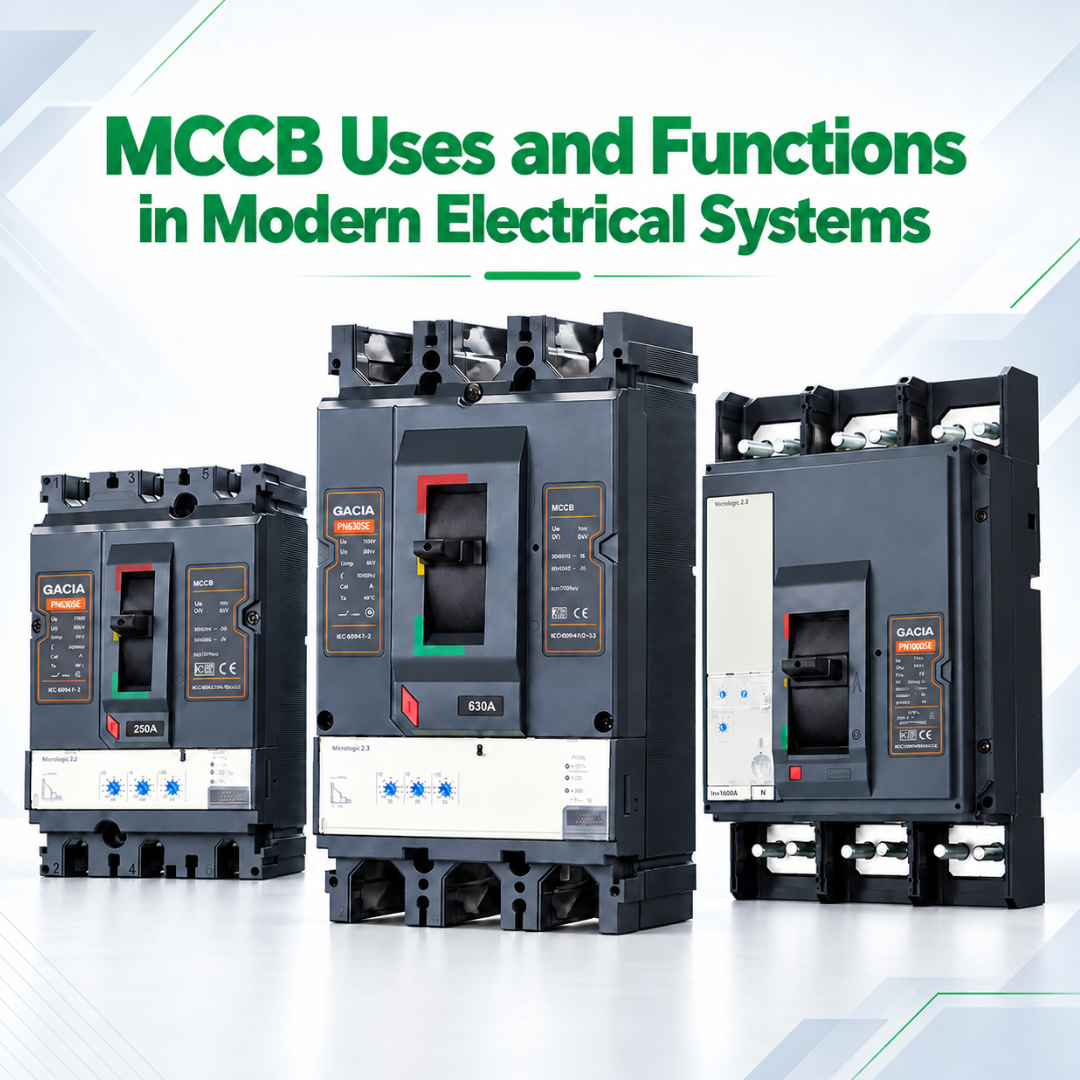
GACIA PN250
The GACIA PN250 is offered in both the three-pole and four-pole variations, employing frame sizes of 100A, 160A and 250A for an operating current range of up to 250A.
It is able to use both thermal-magnetic trip units and electronic trip units, with the options to function at AC415V, AC500V and AC690V. The PN250 can offer breaking-capacity possibilities of up to 50kA in the S class and 85kA in the H class at AC415V. The product fulfills the requirements of IEC 60947-2 standards.
GACIA PN630
The PN630 provides rated-current ranges from 250A to 630A, with 3P and 4P configurations.
There are options available for thermal-magnetic and electronic tripping, and it is compatible with AC 415V, AC 500V, and AC 690V systems. The ultimate breaking capacity of the box varies based on the breaking capacity, with two options of either 50 kA or 85 kA at AC 415V.
GACIA PN1600
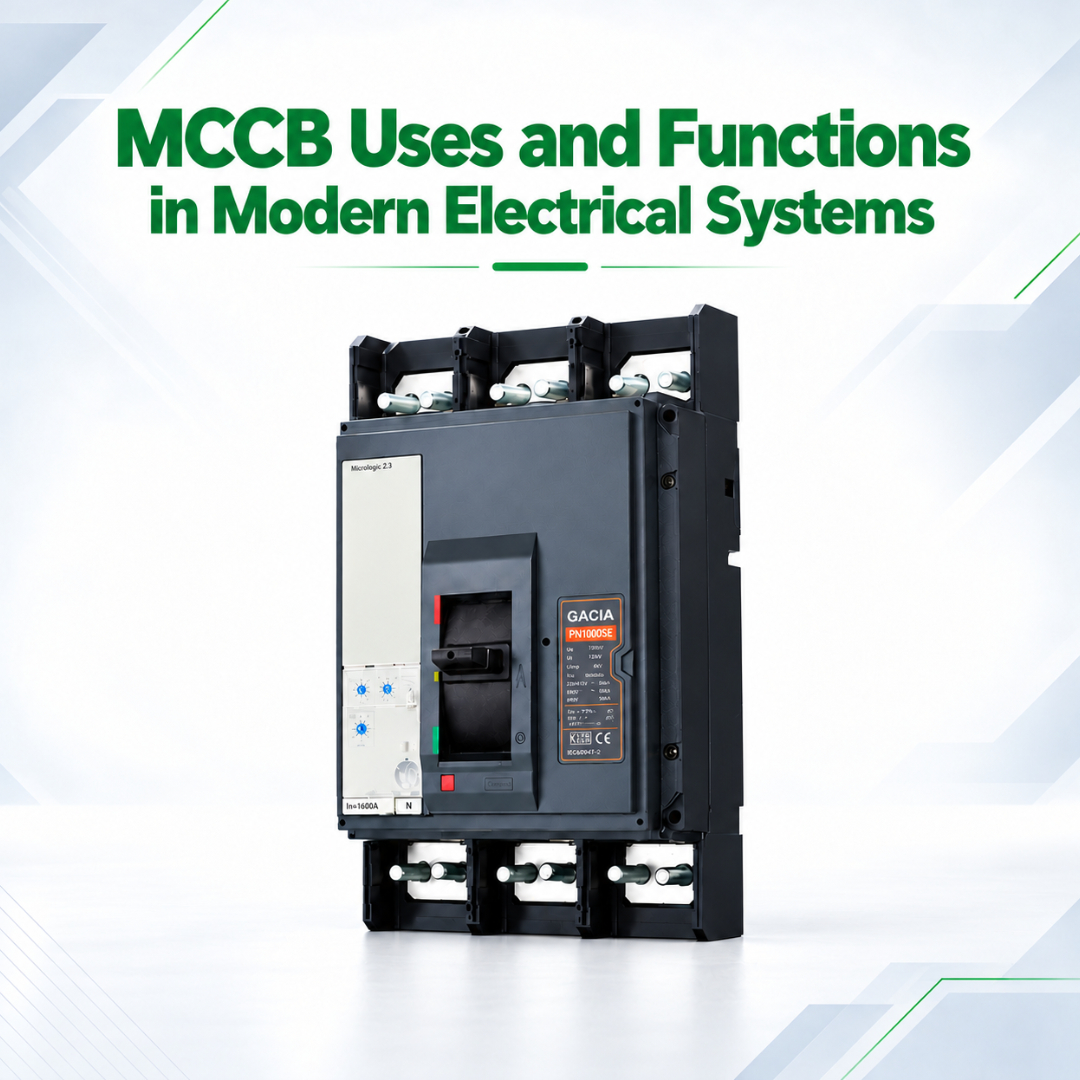
For higher-current distribution, the PN1600 extends the PN Series to 800–1600A.
The apparatus can be obtained in 3P and 4P types, equipped with an electronic trip unit. Furthermore, the equipment is designed for operating voltages of AC415V, AC500V, or AC690V. In the case of AC415V, the breaking capacity of 50kA is reached by the S type, and for the H type it is 65 kA.
Key Specifications to Compare
- Rated current
- Rated operating voltage
- Breaking capacity
- 3P or 4P configuration
- Thermal-magnetic or electronic trip unit
- Installation and coordination requirements
- Applicable standards
Just because an MCCB has a higher current rating or breaking capacity does not mean that it is automatically better. The breaker must be in accordance with the demands of the load, the cable capacity, and the prospective fault current.
Conclusion
Molded-case circuit breakers (MCCB) include electrical protection, switching, and isolation by design, which is suitable for commercial and industrial electrical distribution systems.
The GACIA PN250, PN630, and PN1600 exhibit various current limits, enabling designers, contractors, and purchasers to choose the right MCCB compliant with the real size and safety specifications of the power distribution networks.