




Molded Circuit Breaker Factory in China: What Global Buyers Should Know
China has established itself as a key sourcing market for molded case circuit breakers (MCCBs), offering a wide range of products to global customers across various industries. However, choosing the right molded case circuit breaker manufacturer in China goes beyond price comparisons. Critical assessments of product specifications, testing abilities, adherence to standards, consistency of production, as well as availability of technical assistance should all factor into the selection process.
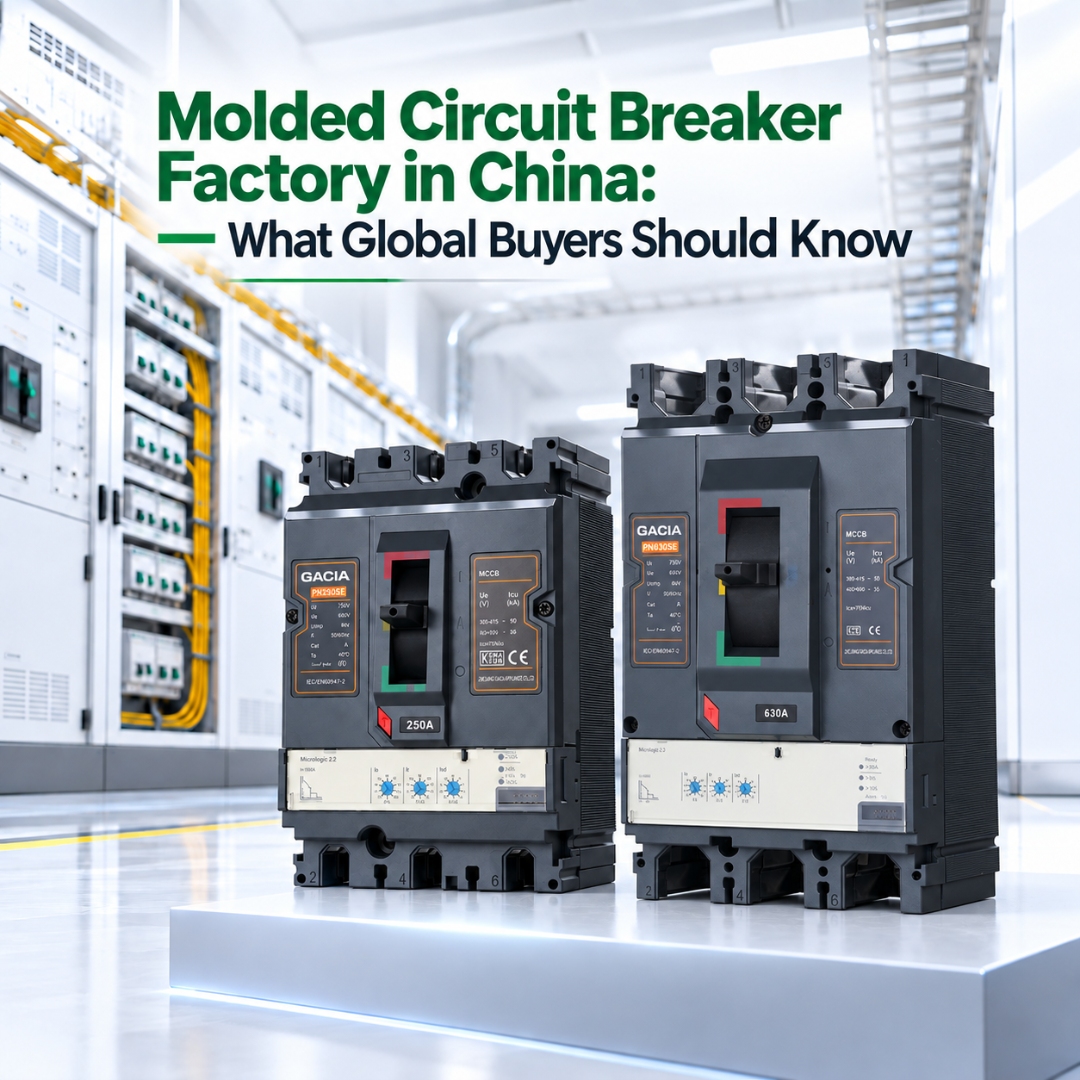
This guide talks about important considerations for buyers when looking for MCCBs from China and also provides information about GACIA's PN series that illustrates how molded case circuit breakers like PN250 and PN630 work depending on the different requirements.
What Is a Molded Case Circuit Breaker?
An MCCB, or molded case circuit breaker, is essential in safeguarding electrical systems and devices from short-circuit and overloaded conditions. In most power distribution systems, where higher current and breaking capacity needs arise, MCCBs are frequently utilized.
Depending on its design, the MCCB can have a thermal-magnetic or electronic trip unit. Various frame sizes, rated currents, breaking capacities, and pole configurations enable users to choose a breaker depending on the needs of the electrical system.
What Should Buyers Look for in a Molded Circuit Breaker Factory in China?
When evaluating an MCCB supplier, buyers should focus on several practical factors.
Product Range: Make sure to find out if the producer offers various frame sizes, amp levels, breaking capacities, and trip-unit choices. The larger the selection, the easier it is to find appropriate products for different job sites.
Standards and Certification: Ensure that the product conforms to the standard specified for the target market. All necessary certificates and testing documentation should be examined prior to procurement of large quantities.
Testing and Quality Control: Electrical and mechanical testing should be done on MCCBs to determine their operational and protective capabilities.
Technical Support: It is crucial to have clear data sheets, installation information, accessory options, and responsive technical communication while dealing with an overseas supplier.
Customization: Those customers seeking OEM or private-label products should consult the producer regarding branding specifications, packages, and available product configurations before placing the order.
Thermal-Magnetic vs Electronic MCCBs
One important consideration when selecting an MCCB is the type of trip unit.
Thermal-magnetic MCCBs utilize a thermal device for overload safety as well as an electromagnetic arrangement for immediate short-circuit safety. Owing to their rather uncomplicated design, these electrical devices can be utilized in numerous ordinary distribution applications.
Electronic MCCBs: Electronic sensing can be utilized to ensure more accurate and adaptable features of protection. If we consider the design of the product, we will see that electronic devices make it possible to provide the coordinates of the circuit and its protection far more adaptable.
The correct option will depend on the functional properties needed, system set-up, and details regarding the project.
GACIA PN Series Molded Case Circuit Breakers
The PN Series is part of GACIA's molded case circuit breakers range, which are aimed at AC power distribution systems functioning on 50Hz or 60Hz frequency. The rated ranges of current and voltage that fall within the scope of the series are 12.5A to 1600A and a maximum of 690V, respectively. The circuit and electrical equipment that could be in danger of being affected by overload, short-circuit, or undervoltage power situations can be secured effectively using the devices of this particular series as per GACIA.
The PN Series conforms to the specifications of IEC 60947-2 and is certified by KEMA and CE. Both thermal-magnetic and electronic designs within certain models.
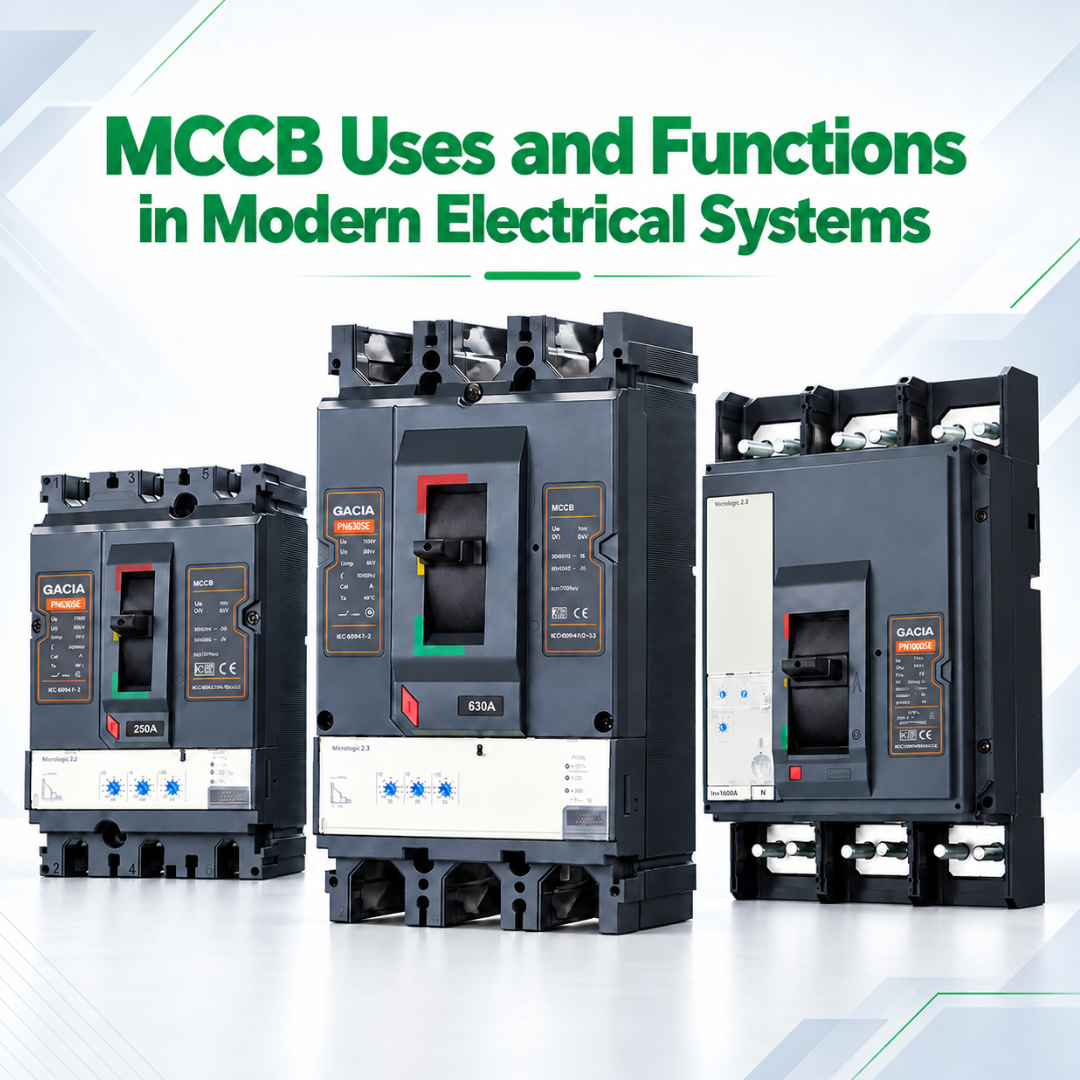
GACIA PN250 MCCB
The GACIA PN250 belongs to the PN Series of circuit breakers that feature molded cases. This product provides a range of current ratings ranging from 12.5 A to 250 A for frame sizes of either 100 A, 160 A, or 250 A. It is provided in configurations of both 3 poles and 4 poles with the rated operating voltage of AC415 V, AC500 V, and AC690 V.
The thermal-magnetic or electronic trip units come in various options for the PN250. According to GACIA, breaking capacity is of two levels: S and H levels. The rated ultimate breaking capacity at AC415V can achieve 50kA for the S level and 85 kA for the H level.
The features also comprise the double-break contact design, optimized arc-extinguishing construction, as well as no-flier arc distance. These features aim to facilitate installation in power distribution panels and minimize arcing and thermal stresses while breaking.
GACIA PN630 MCCB
In terms of higher current usage, the GACIA PN630 ranges from 250A to 630A, with the frames at either 400A or 630A. Its configuration is available for 3P and 4P, enabling operation at a voltage of AC415V, AC500V, and AC690V.
Similar to PN250, the PN630 can be utilized with thermal-magnetic and electronic trip device variations. At an AC voltage of 415V, GACIA provides an ultimate breaking capacity of 50kA for the S configuration and 85kA for the H version.
The PN630 is also designed with a two-break contact construction, an efficient arc-extinguishing design, and no flying arc distance. In addition to this, GACIA also provides additional features such as a shunt release, undervoltage release, and accessories like auxiliary contact, alarm contact, and operating mechanism.
PN250 vs PN630: How Do They Differ?
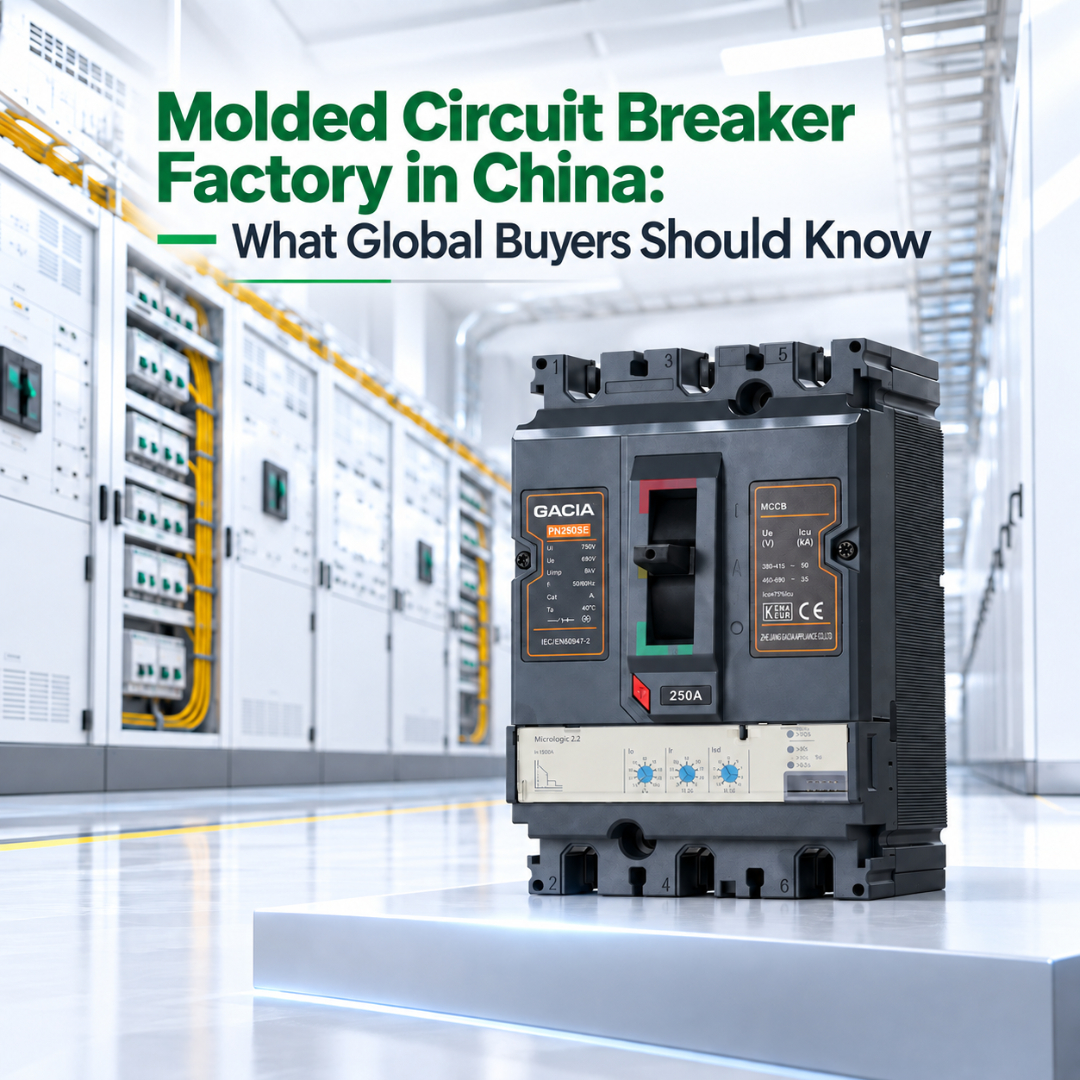
The fundamental distinction separating the PN250 from the PN630 is that the former’s operating current range and chassis dimensions are different from those of the latter. Whereas the operating current range of the PN250 is from 12.5A up to 250A, the PN630 operates within a current range of 250A to 630A.
The two models are offered in both 3P and 4P types, with the power supply rated to work on the AC415V, AC500V, and AC690V systems. They provide the option of thermal-magnetic and electronic trip units, making it easier for users to choose the desired model based on the current and voltage rating, needed tripping capacity, and protection specifications.
How to Evaluate an MCCB Supplier
Buyers must ensure both production capability and product specifications when choosing a supplier for moulded case circuit breakers.
Check Technical Data: Compare the rated current, rated voltage, breaking capacity, number of poles, and the type of the trip unit with what the project requires.
Review Certificates: Confirm that certificates and standards match the intended market and application.
Request Samples: Product evaluation samples are useful in assessing product design, labelling, and technical properties before bulk orders are placed.
Review Manufacturing Capability: When assessing a company producing mold case circuit breakers, one can inquire about the manufacturing machinery used, testing methods, and quality assurance systems.
Confirm Accessories: It is essential to note that MCCB accessories are key components of control, signaling, and panel interfacing. Always verify compatibility before passing the configuration of the products.
Common MCCB Sourcing Mistakes
Focusing Only on Price: A low unit price should not replace evaluation of specifications, testing, and product consistency.
Choosing the Wrong Breaking Capacity: The value of breaking capacity shall be chosen based on the possible short-circuit current for the installation.
Ignoring Trip-Unit Differences: Thermal-magnetic and electronic MCCBs serve different protection and adjustment requirements.
Not Verifying Documentation: Before making a mass order, it is vital to examine product certificates, technical data sheets, and product markings.
Conclusion
It's important to carefully evaluate the product specifications, standards adherence, testing capacity, and technical assistance that a molded circuit breaker factory in China has to offer.
In the PN Series of GACIA, various options of MCCBs are offered, meeting the requirements of different types of current. For example, PN250 can handle a maximum load of 250A, while the maximum rated current for PN630 is 630A. Both devices have thermal-magnetic and electronic options, 3P and 4P configurations, and different levels of breaking capacity.
When selecting a moulded case circuit breaker supplier, global buyers must weigh these technical aspects in relation to the requirements of the electrical system. Understanding the current rating, voltage, breaking capacity, type of trip unit, and accessories will assist buyers in making informed sourcing decisions.