






RCBO vs RCCB: Panel Space, Wiring and Installation Compared
When choosing between an RCBO and an RCCB, consider how the low- voltage circuit breaker type affects panel space, wiring, fault isolation, and maintenance. Therefore, understanding the history of RCBOs and RCCBs can help contractors, builders, and their customers select a suitable breaker for residential or commercial use.
What Is the Difference Between RCBO and RCCB?
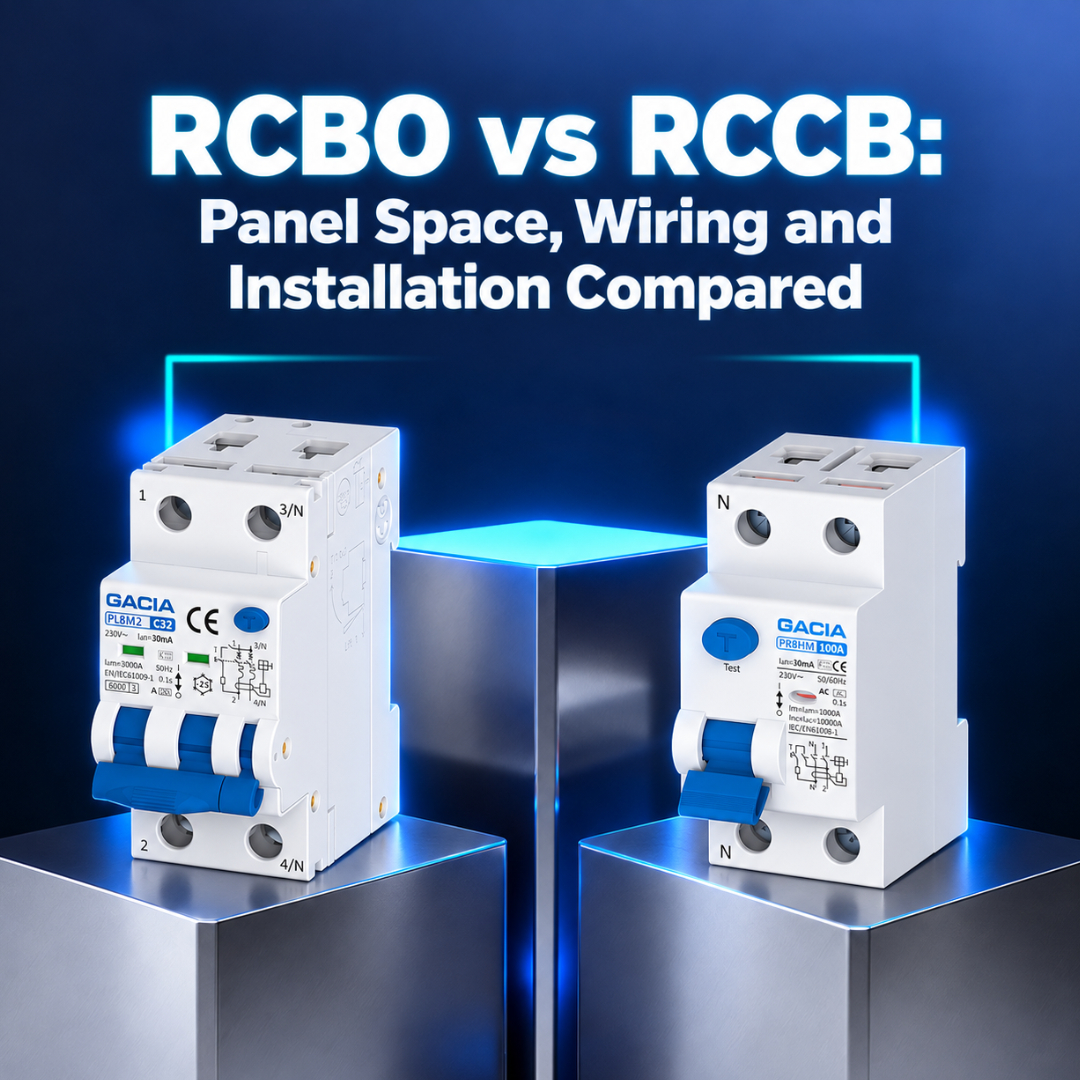
The Residual Current Circuit Breaker with Overload capacity (RCBO) function is twofold: it provides residual protection and overload protection, unlike the Residual Current Circuit Breaker (RCCB), which provides only the residual function.
Panel Space and Wiring
RCBOs offer individual protection for every circuit and help make panel designs easier, especially in the case of compact units. RCCBs are installed upstream for a number of circuits, with MCBs providing short-circuit protection for the appropriate branch.
The actual space needed depends on the width of the product and the number of circuits, as well as the protection arrangement. Therefore, customers need to analyze the overall layout rather than assume that one solution will take up a smaller amount of space.
Fault Isolation
By using an RCBO, only the malfunctioning circuit is generally disconnected due to faults, which helps to cut down on time spent on repairs as it makes resolving issues quicker.
If multiple downstream circuits are being protected by a single RCCB, an earth leakage fault can lead to the disconnection of all such circuits. Thus, RCCBs are efficient when it comes to group protection, whereas RCBOs are better suited for protecting circuits independently.
GACIA RCBO and RCCB Solutions
GACIA provides various products for protection against low voltage, such as MCBs, RCCBs, RCBOs, smart circuit breakers and MCCBs.
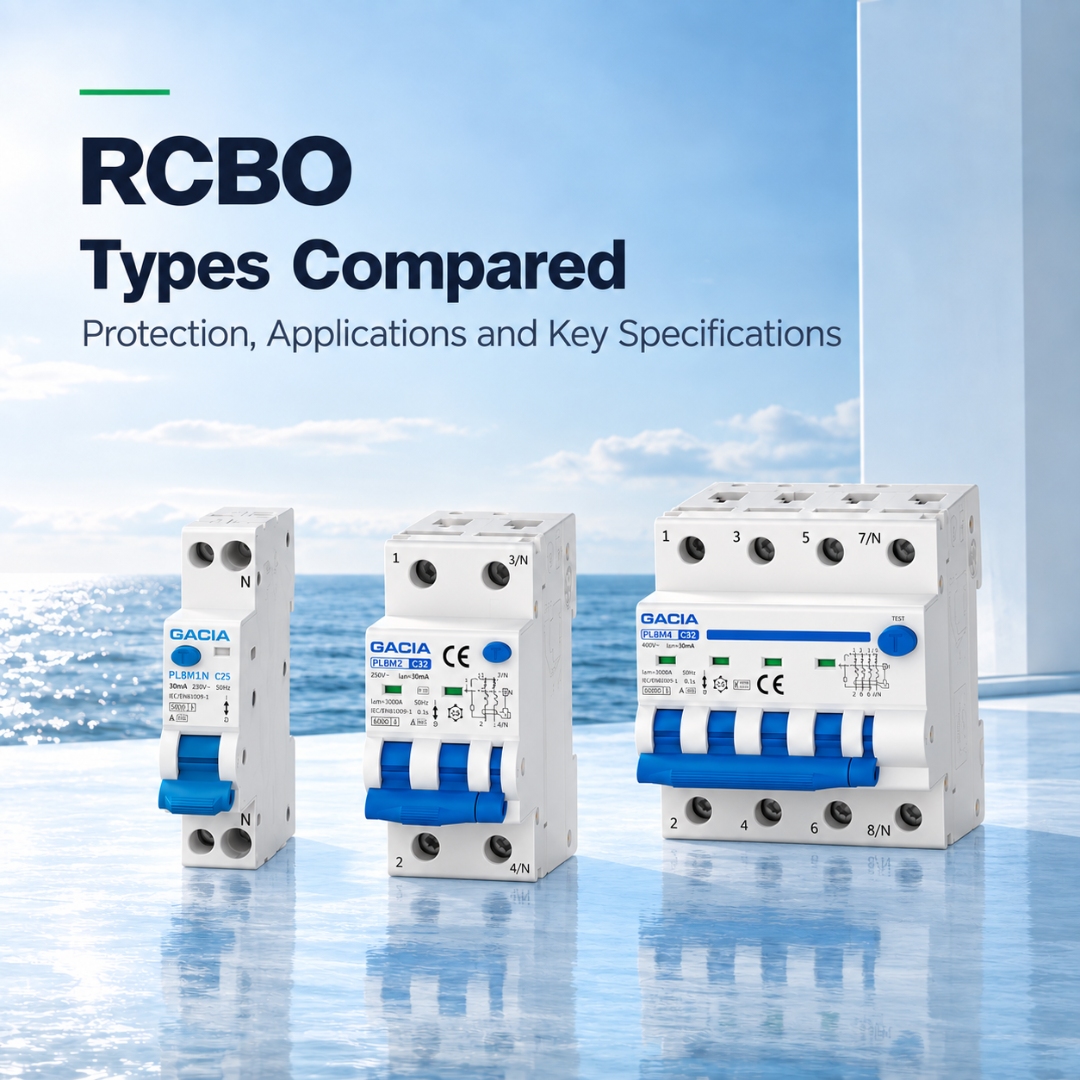
GACIA PL8M1N RCBO
The GACIA PL8M1N is a compact 1P+N RCBO with an 18mm single-module size. It handles rated current from 6A to 25A and has a breaking capability of 6kA. The device fulfills the requirements of the IEC/EN 61009-1 standard, which makes it suited for installations where space is constrained in the electrical panel.
GACIA PR8HM RCCB
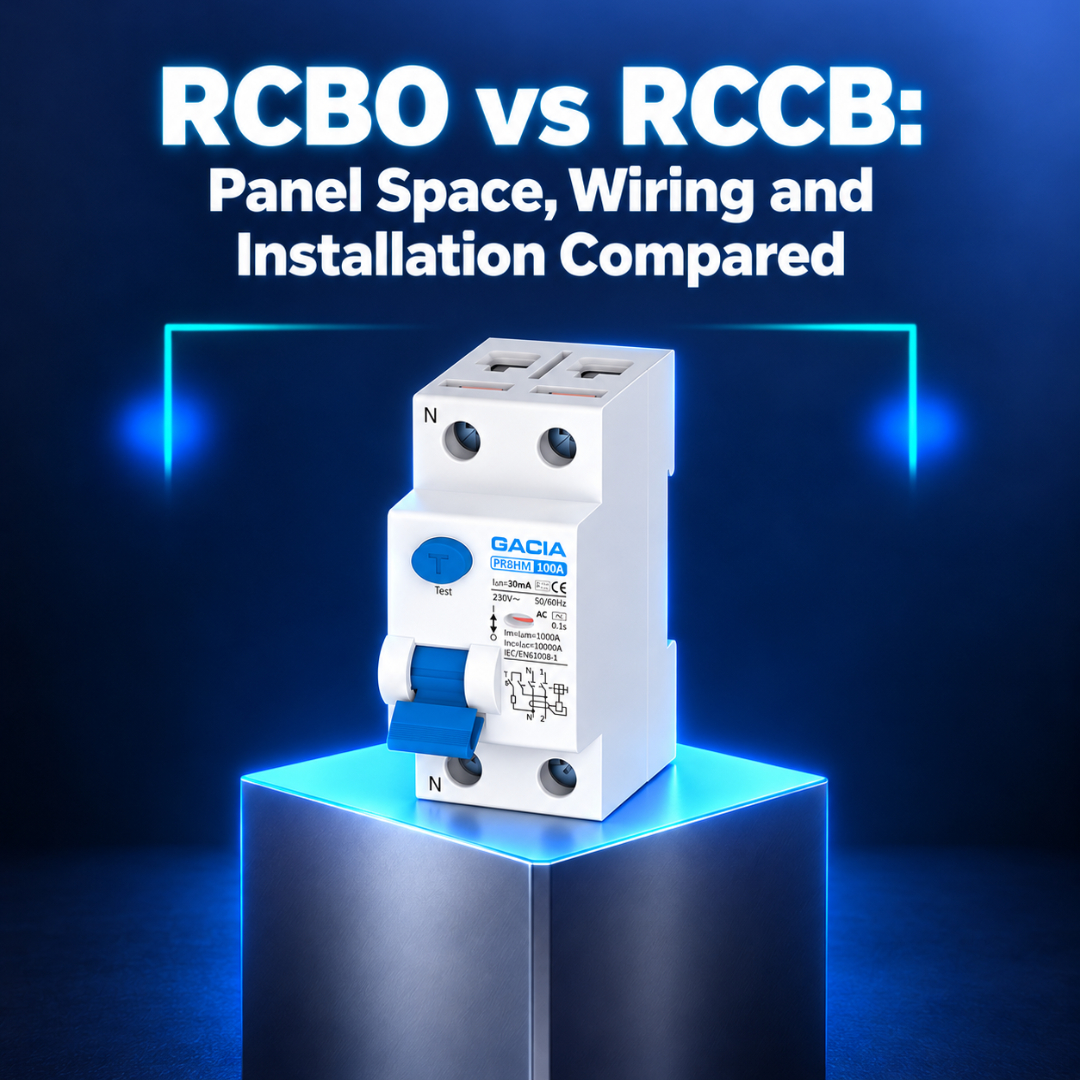
Rated currents vary from 25A to 100A for the GACIA PR8HM, which comes in 2P and 4P configurations. Residual-current ratings are also available in levels of 10 mA, 30 mA, 100 mA, and 300 mA. Compliance with IEC/EN 61008-1 is guaranteed.
Since the RCCB does not have built-in protection for overcurrent, it is necessary to use it alongside a suitable MCB or other overcurrent protection device in order.
How to Choose Between RCBO and RCCB
Take into account the number of circuits, available space on the DIN rail, need for fault isolation, as well as rated current, residual current for operational purposes, and future expansion plans.
When it comes to individual protection of circuits as well as facilitated fault isolation, choosing an RCBO circuit breaker is a good option. By contrast, the use of an RCCB with MCBs can be a solution if there are a number of connecting circuits for residual current protection.
Conclusion
The decision between which one to use between the RCBO and the RCCB would depend on factors such as how the panel is designed, wiring types needed, protection requirements, and maintenance methods. While the RCBO offers both residual current and overcurrent protection in one device, the RCCB only offers residual current protection, with a separate miniature circuit breaker used in conjunction with it.
With GACIA's products like the PL8M1N RCBO and PR8HM RCCB, consumers can pick either option so that they can choose the right low-voltage breaker to suit their tasks.