





Why Compact RCBO Design Matters in Space-Limited Electrical Panels
As more circuits and devices are used in electrical panels, available DIN-rail space plays a more and more vital role in building electrical panels. A compact RCBO is useful in making the most of the limited panel space while combining residual current, overload, and short-circuit protection in one device.
Panel builders, contractors, and purchasers should look at low-voltage breakers and not just check the simple physical size. It is important to check rated current, residual current, breaking capacity, trip characteristics, and relevant standards.

What Does an RCBO Do?
An RCBO, or Residual Current Circuit Breaker with Overcurrent Protection, is a protection device that combines residual current protection with overcurrent and short-circuit protection.
A typical miniature circuit breaker (MCB) protects against overload conditions and short circuits but cannot provide residual-current protection. The RCBO merges both functionalities into one device, giving it an edge to be utilized for the purpose of protecting individual circuits in both residential and commercial distribution boards.
Why Compact RCBO Design Matters
The space available on distribution boards with DIN rails is limited. This means that the dimensions of the various devices used in the cabinet will gain attention in the design process if new circuits or protection features are required.
Compact RCBOs can help save space for circuit protection as opposed to larger types of RCBOs. This is especially important in renovation projects and in apartments and compact distribution boards where changing the enclosure or making it bigger is not an acceptable option.
Yet, the design should not just be evaluated based on its compact size. Adequate consideration should also be given to key factors including wiring and access to terminals, heat dissipation, and future upgrades of the circuit.
GACIA Compact RCBO Solutions
Founded in 2002, GACIA specializes in researching, manufacturing, and marketing low-voltage circuit breakers. Its offerings include MCBs, RCCBs, RCBOs, MCCBs, and smart circuit breakers used for power distribution in residential, commercial, and industrial applications.
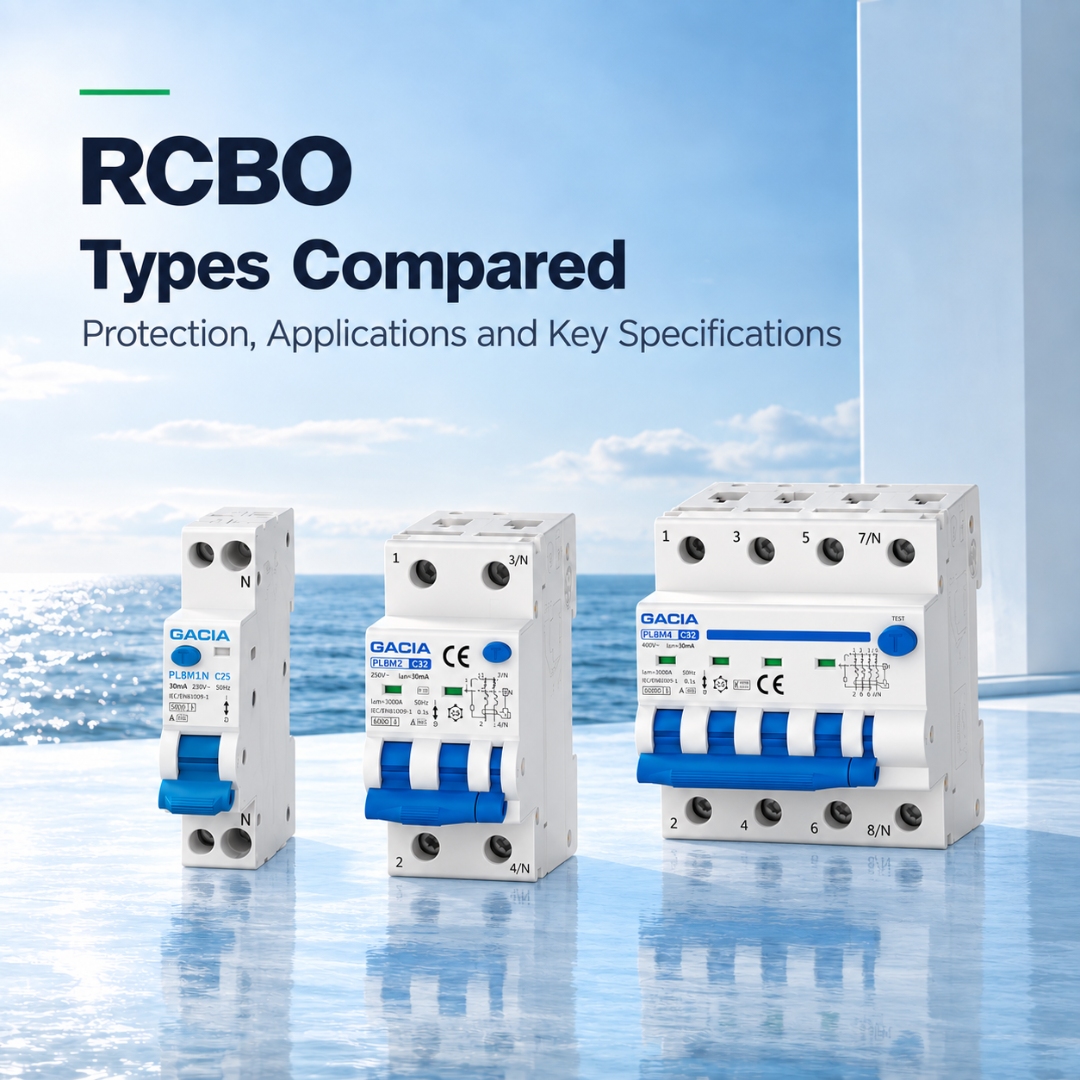
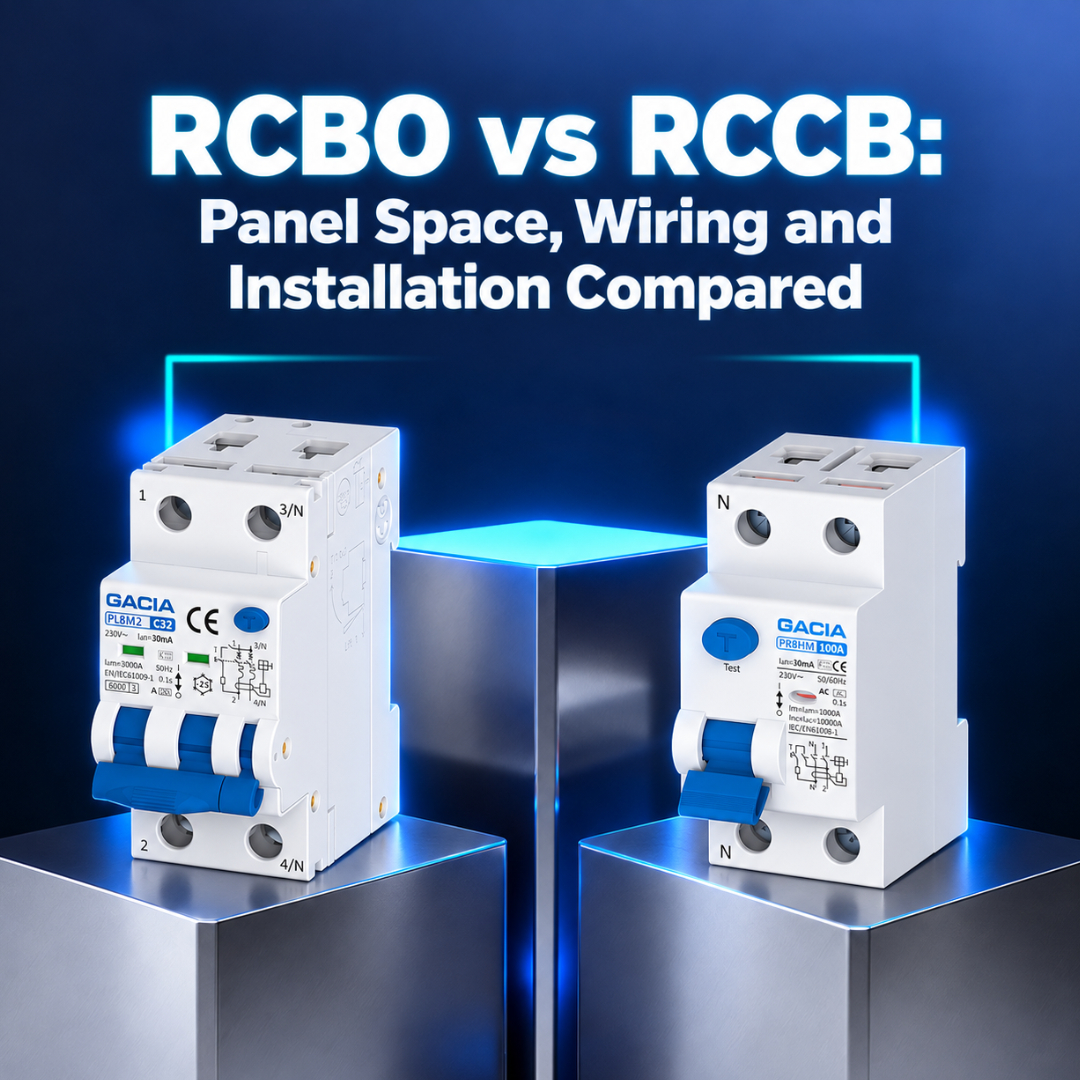
In the Professional P Series, the company GACIA provides a variety of configurations of RCBOs according to the protection and installation requirements. For instance, the two models include the compact PL8M1N and the PL8M2.
GACIA PL8M1N 18mm RCBO
The GACIA PL8M1N is intended for applications where the available space in the DIN rail is inadequate. It features a 1P+N configuration and occupies a space of only 18mm in width which makes this product ideal for small residential distribution boards and renovation applications.
The PL8M1N is rated for current values between 6A and 25A and has a breaking capacity of 6kA. It is available in B and C tripping classes as well as in Type AC and Type A RCDs. The rated residual current options are 30mA, 100mA, and 300mA, and it is compliant with IEC/EN 61009-1 standards.
GACIA states that its 18mm product design can save up to 50% of the installation space compared to its original traditional product. This makes it possible for PL8M1N to fit into some existing distribution boards without requiring bigger cabinets.
Employing an electromagnetic RCBO design, this item integrates residual current, overcurrent, and short-circuit protection in a compact unit.
GACIA PL8M2 2P RCBO
The GACIA PL8M2 can also be used in the Professional P Series low-voltage circuit breaker for applications requiring the two-pole arrangement.
The PL8M2 is an electromagnetic RCBO that has a rated current ranging from 6A to 40A. It offers a standard breaking capacity of 6kA over the 6A-40A range, while the chosen versions of 6A-16A have a breaking capacity of 10kA.
The device functions at a voltage of 230/400 volts with the tripping characteristics B and C, while a range of residual current options is given – 30, 100, and 300 mA with sensitivity types AC and A.
PL8M2 demonstrates compliance with IEC/EN 61009-1 and is certified with CE and KEMA markings. Its electromagnetic design integrates a residual-current function in addition to thermal protection and magnetic short-circuit protection, providing suitability for different low-voltage applications, including residential, commercial, and industrial.

PL8M1N vs PL8M2: Different Solutions for Different Panels
Although both products are RCBOs, the PL8M1N and PL8M2 address different installation requirements.
The PL8M1N places heavy emphasis on space efficiency. The 1P+N configuration fits in a single 18mm module, which is capable of carrying currents of up to 25A, with a breaking capacity of 6kA. This space-saving design also comes in handy in small residential panels or refurbishment work limited in DIN-rails.
The PL8M2 has a 2P design, which means that it utilizes a 2P configuration, giving it a rated current of 40A. Some of the lower current configurations can yield up to a maximum breaking capability of about 10kA. Hence, there is more flexibility in instances where a two-pole configuration is required.
While both equipment options offer combined protection against residual and overcurrents, the right option will depend on the particular requirements of the electrical installation, pole structure, fault current characteristics and space in the panel.
RCBO vs Miniature Circuit Breaker in Compact Panels
A miniature circuit breaker is one of the most widely used devices for the protection against overloads and short-circuits in final circuits. Where residual current protection is also required, designers can either incorporate the miniature circuit breaker along with an RCCB or select an RCBO that combines both protective functions in one device.
This does not imply that an RCBO must replace any MCB. It is essential to set up the proper protection system in order to achieve something that works effectively and is still safe.
Nevertheless, in a panel where there is a shortage of space, it is possible to employ a compact RCBO to reduce the number of protective appliances required by one circuit.
Why Compact RCBOs Are Useful in Renovation Projects
Renovation plans often involve old distribution boards, which means that available space is small. However, new equipment, new wiring or enhanced protection measures can lead to an increase in the number of devices to be installed.
The challenge can be solved using a small RCBO without increasing enclosure size. For example, the PL8M1N is designed in the 1P+N 18mm format and is meant, according to GACIA, for renovation purposes where it can be used within existing distribution-box enclosures.
When a project demands a 2P setup or higher, the PL8M2 offers an alternative. It accomplishes this while maintaining the dual protective capabilities of an RCBO.
What Should Buyers Check When Choosing an RCBO?
The size is important; however, it should be just one of the factors to take into account when selecting an RCBO. When selecting an RCBO, one needs to take into account:
- Rated current
- Rated voltage
- Residual operating current
- Breaking capacity
- Number of poles
- B or C tripping characteristics
- Type AC or Type A residual-current sensitivity
- Applicable product standards
- Available DIN-rail and wiring space
Breaking capacity is very significant. The right device must have the appropriate short-circuit current rating at the installation site. One of the mistakes people often make is to choose the least powerful one and ignore electrical functionality at the same time.
Panel Space Is More Than Device Width
Using an 18mm RCBO can prove to be very space-efficient, but it is important to consider wiring and accessibility in good panel design.
It is necessary for conductors to be provided with enough space for routing and termination, while devices must be accessible for installation, testing, and maintenance. Designers need to take into account whether or not more circuits may need to be installed in the future too.
Hence, this is why compact protection devices are of great significance when they are incorporated into a well-designed distribution-board arrangement rather than being used only with the objective of installing maximum devices on a DIN rail.
Compact Design Without Compromising Selection Requirements
Even though the housing is smaller, it does not eliminate the necessity to check the electrical specifications. The RCBO must still fulfill the protection criteria for the circuit as well as the applicable product standard.
Devices like the GACIA PL8M1N and PL8M2 are indicative of the varying styles of RCBOs that are being created for different applications. The focus of the PL8M1N is on minimum width, whereas the emphasis of the PL8M2 is on providing a two-pole design with a higher current rating and improved breaking characteristics.
Instead of only getting an RCBO based on its size, the buyers must select the appropriate RCBO corresponding to the circuit and installation conditions.
Conclusion
The implementation of a compact design for a residual current circuit breaker with overload protection is essential as it enables panel manufacturers and installers to efficiently utilize the available rail space while integrating overload, earth fault, and short-circuit protection functions into one device.
The GACIA PL8M1N illustrates this concept with an 18mm 1P+N format, with current ratings ranging from 6A to 25A and a breaking capacity of 6kA. The PL8M2 improves upon this by offering a 2P configuration and current ratings of up to 40A, with certain models having a breaking capacity of 10kA.
When assessing the quantity needed, it is imperative to realize that choosing an RCBO must depend on more than just the size and weight of the device. The consumer should consider parameters such as the panel space, current rating, breaking capacity, residual current characteristics, and circuit design.